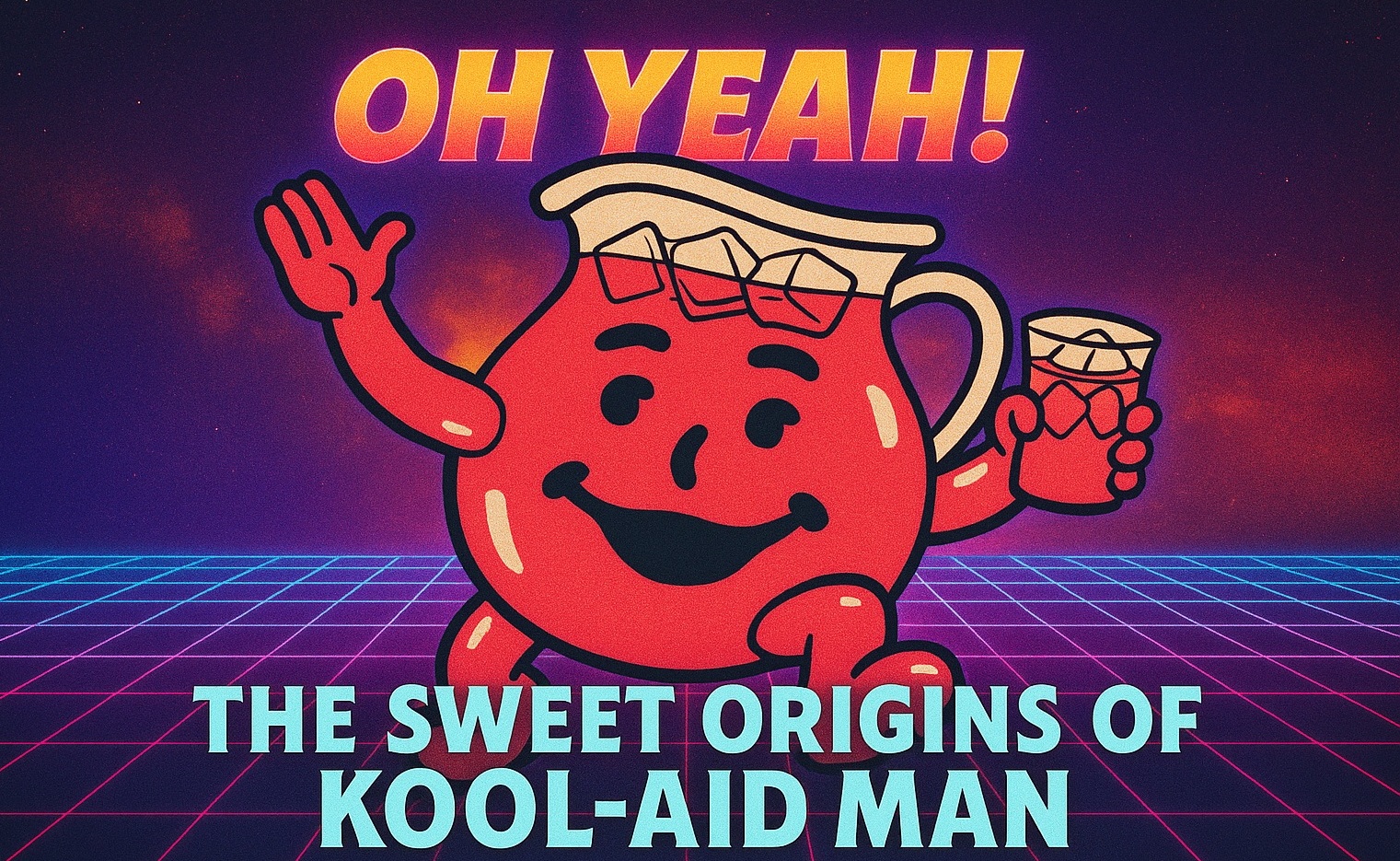
OH YEAH! The Sweet Origins of Kool-Aid Man and His 80s Explosion

Move over, mascots—there’s only one pitcher who can burst through a brick wall with a grin and a glass of red-flavored joy. Say it with me now: “OH YEAH!”
The Kool-Aid Man is more than just a walking beverage dispenser with biceps and bravado. He’s a pop culture force, a sugary symbol of 1980s fun, and a marketing juggernaut who turned hydration into a full-blown spectacle. But long before the big red guy became an icon of Saturday morning cartoons and sugary snack breaks, there was a humble powdered drink mix born in the heartland of America.
A Little Drink Called Kool-Aid
It all started in 1927, in Hastings, Nebraska, when inventor Edwin Perkins developed a concentrate called “Fruit Smack.” Realizing the cost of shipping liquid was holding the product back, Perkins used his kitchen chemistry to dehydrate the drink into a powder. Thus, Kool-Aid was born. It came in six flavors, sold for just 10 cents a packet, and was marketed as a delicious, economical refreshment for families across America.
Kool-Aid quickly became a Depression-era staple. During the 1950s and 60s, it was a fixture in suburban kitchens, often accompanied by kids with cherry-stained mouths and popsicle-stick mustaches. But it wasn’t until the 1970s that the brand decided it needed a mascot to pour on the personality.
Enter: Kool-Aid Man
In 1975, the Kool-Aid Man was introduced—originally called “Pitcher Man”—as a smiling anthropomorphic pitcher full of fruity drink and uncontainable energy. The early commercials were simple: a group of kids would complain about being bored or thirsty, and BOOM! Kool-Aid Man would bust through a wall, yelling his now-iconic catchphrase, “OH YEAH!”
The concept was both absurd and brilliant. Here was a character who physically embodied the product and literally broke through obstacles to bring kids joy. Who wouldn’t want their thirst solved via wall demolition?
A Full-Blown 80s Superstar
While Kool-Aid Man made his debut in the late ‘70s, it was the 1980s that truly turned him into a pop culture phenomenon. He got a beefy redesign with muscular arms and legs, making him more dynamic—and let’s face it—way more fun to animate. His TV spots ran during Saturday morning cartoons, and his merchandise exploded onto store shelves: lunchboxes, coloring books, T-shirts, and even his own comic book series published by Marvel.
Yes, Marvel Comics.
In the comic, Kool-Aid Man battled the “Thirsties,” evil creatures bent on dehydrating the world. It was delightfully ridiculous and exactly the kind of zany, over-the-top storytelling that defined the era.
He even had a video game on Atari and Intellivision. (It was… not great. But hey, he tried.)
The Wall-Smashing Legacy
Though his presence on TV cooled off in the 1990s, the Kool-Aid Man never truly went away. He’s been rebooted a few times, including a CGI version, but fans of the original still cherish his 1980s form—the one that could shatter drywall with a smile and a sugar rush.
Kool-Aid Man represents more than just a drink mascot. He’s a reminder of a time when advertising was bold, colorful, and delightfully weird. He broke the fourth wall, literally and figuratively, to become one of the most enduring mascots in history.
So next time you see a brick wall… listen closely. You just might hear the faint echo of a joyful cry:
“OH YEAH!”